Bridging the Gap Between Science of Reading and the Reality of the Classroom
Written for Educators Who Want to Make Evidence-Aligned Instruction Stick

We are currently in the midst of a vital “Reading Revolution.” Across the country, school districts are finally moving away from debunked “balanced literacy” models in favor of the Science of Reading (SoR). This shift is a monumental victory for student literacy.
However, as we implement these changes, a new challenge has emerged: many classrooms are adopting the content of the Science of Reading without updating the instructional delivery.
To truly move the needle, we must recognize that the Science of Reading identifies the “what” of literacy. To make it stick, we must bridge it with Learning Science (the cognitive mechanics of how the brain acquires and retains information) and Instructional Science (the pedagogical architecture of effective design and delivery of instruction).
Managing the “Bottleneck”: Learning Science, Cognitive Load and Schema Theory
The Science of Reading identifies the essential "ingredients" for literacy, often visualized through Scarborough’s Reading Rope. But Learning Science provides the “recipe” for processing those components.
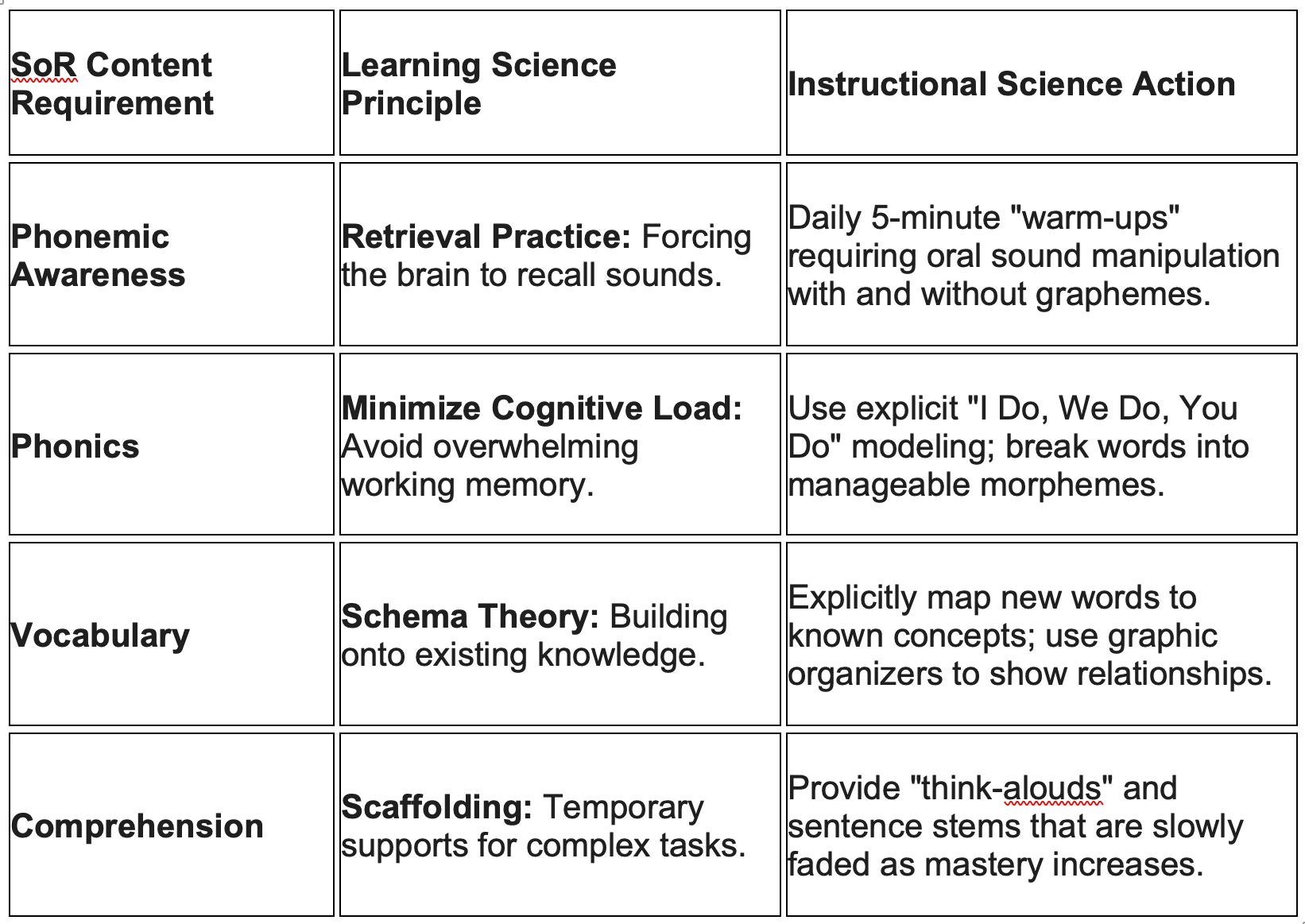
Learning to read is cognitively “expensive.” It places an immense burden on a child’s working memory. According to Cognitive Load Theory, if we introduce too many new concepts at once, the brain “bottlenecks,” and learning stops. To maximize the effectiveness of SoR, we must present new learning in small steps—for example, breaking complex decoding tasks into manageable segments to ensure the brain can process each piece without short-circuiting (Sweller, 1988).
In addition, learning science posits that new information is understood through connections to existing knowledge. Joining previously learned knowledge and skills to new knowledge through effective instructional design allows teachers to systematically build the background knowledge (schema) necessary for high-level comprehension (Willingham, 2009).
The Mechanics of Effective Pedagogy: Instructional Science
Instructional science answers the “how” of the Science of Reading through evidence-based architectures of delivery. This is best exemplified by Rosenshine’s Principles of Instruction, articulated in Engelmann and Carnine’s Theory of Instruction, and demonstrated in Archer & Hughes’ Explicit Instruction.
Beyond the lesson structure, we must prioritize Opportunities to Respond (OTR). Research suggests that struggling readers may require 10 to 30 times more practice than their peers to reach “automaticity” (Hattie, 2009). High OTR—using mini-whiteboards, choral responses, ample spaced and cumulative practice, for example—is one way to achieve this volume of practice within a standard literacy block (MacSuga-Gage & Simonsen, 2015).
Scaffolding: The Bridge to Independence
While the Science of Reading identifies the complex skills students must master—such as multisyllabic decoding or deep inferential comprehension—learning science reminds us that many students cannot jump into the deep end without support. This is where scaffolding comes in.
In an instructional context, a scaffold is a temporary support used to help a student reach a goal they cannot yet achieve independently. Just as a physical scaffold is removed once a building can stand on its own, instructional scaffolds must be systematically “faded.”
The Zone of Proximal Development: Scaffolding allows students to work within their “sweet spot”—tasks that are challenging but achievable with clear guidance.
Types of Scaffolds: This includes verbal prompts (reminding a student of a phonics rule), visual aids (anchor charts for vowel teams), or procedural supports (graphic organizers for story mapping).
The Danger of “Permascaffolding”: A common pitfall in literacy is keeping the supports in place too long. Instructional science emphasizes that for the Science of Reading to result in fluent, independent readers, we must have a plan to “fade” the support as the student’s internal “neural scaffolding” becomes stronger (Rosenshine, 2012).
The Unified Framework
When we merge these three sciences, the instructional model evolves from a list of topics into a high-performance system:
Precision Through Immediate Feedback
In the Science of Reading, accuracy is the precursor to fluency. If a student practices an error, they risk “wiring” that error into their long-term memory.
Instructional Science emphasizes Immediate Corrective Feedback. If a student misreads a word, the teacher intervenes instantly to direct them back to the phonetic code. This ensures the neural “trace” being built is accurate from the very first attempt (Archer & Hughes, 2011).
Moving to Long-Term Storage: Retrieval and Spacing
To make literacy instruction durable, we must move beyond "one and done" lessons. We must utilize Retrieval Practice and Spaced Repetition. By forcing the brain to "retrieve" learned skills and information over increasing intervals of time, we move those skills from a struggle in working memory to an automatic reflex in long-term storage (Kirschner & Hendrick, 2020).
The Bottom Line
The Science of Reading has provided us with a long-overdue map of the literate brain. It has identified the “non-negotiables” for every child. But a map alone doesn’t get a traveler to their destination; they need a reliable vehicle and a skilled driver.
By embracing Learning and Instructional Science, we provide teachers with that vehicle. We move away from classroom materials and methods that “cover” the essential components and toward a high-impact pedagogical model that respects cognitive limits, maximizes student engagement, and ensures that every minute of the literacy block is spent building permanent neural pathways.
The goal isn’t just to “do” the Science of Reading. The goal is to make evidence-aligned instruction so effective and so efficient that literacy becomes an attainable reality for every student, in every classroom, every single day. When we bridge the what with the how, we don’t just teach children to read—we ensure they never forget how.
Essential Reading for the “Bridge”:
Language at the Speed of Sight by Mark Seidenberg
Principles of Instruction by Barak Rosenshine
Theory of Instruction by Engelmann and Carnine
How Learning Happens by Paul Kirschner & Carl Hendrick
Why Don’t Students Like School? by Daniel Willingham
Explicit Instruction by Anita Archer & Charles Hughes
Coming soon at the Evidence Advocacy Center The Canon of Literacy: The Three Sciences Framework by Paige Pullen
Managing the “Bottleneck”—done so clearly and concisely, while covering the essential content
Excellent piece. As a science teacher, I am teaching subject content and SoR helps me to teach content through a reading lens, on occasions. Thanks.